
1949 年 10 月之前在沿海运营的其他中国轮船公司
CHINESE COASTAL STEAMSHIP COMPANIES to 1949
China Merchants Steam Navigation Co., Shanghai 招商局輪船公司 (1872)
Chinese Engineering & Mining Co., Tientsin (1889)
San Peh S. N. Co., other Yu Ya-ching companies, Shanghai 三北輪埠公司 (1908)
Ching Kee S. N. Co., Chefoo 政記輪船公司 (1909)
Pre-WWII Chinese owned/chartered shipping from Hong Kong to Kwang Chow Wan, Haiphong & Saigon
Shawhsing S. S. Co., Newchwang (1910)
Imperial Maritime Customs & Chinese Maritime Customs 称大清皇家海关总税务司 和 中国海关总税务司 (1911)
Charles Eddie Hsu (Hsu Ting Zuo) 許延佐 (1922)
"Pei"-named ships (Tientsin) “北”名船(天津) (from 1922)
Chung Hsing 中興煤礦公司、中興輪船公司 (1931)
Wah Shang Steamship Co. (1932)
Dah Loh Industrial Co. Ltd. 大陸航業公司 (1933)
The KPM’s Original Thirteen & VAN DIEMEN, SPEELMAN & SWAERDECROON in China and Japan
China Merchants Steam Navigation Co. Ltd.

MEI FOO
China Merchants Steam Nav. Co. Ltd (CMSNC) -The state-owned Chinese company, which monopolized Chinese-flag steam shipping until about 1897: A short history followed by an illustrated fleet list in 3 parts (up to World War II; Shanghai 1945-50; and Taipei 1949-95) of the China Merchants Steam Nav. Co. Ltd are in the PDFs at right. The General Manager of CMSNC Tong King-sing (Tang Jingxing) formed the Chinese Engineering & Mining Company (CEMC) to supply coal for the ships. The small CEMC fleet, which operated under foreign and Chinese flags, is covered in the Other Chinese section.
The photograph shown above is the coastal steamer MEI FOO of 1880 (Skinner, Inc.), and belwo, the Inglis-built Changjiang (Yangtse) River steamer KIANG YU of 1883 (Graham Thompson coll.) which lasted until sunk as a blockship in 1938, and the coastal steamer HSIN CHI of 1892 (James Adamson coll., University of Glasgow)

KIANG YU

HSIN CHI
HISTORY & FLEET LISTS (PDF FORMAT)
Chinese Engineering & Mining Co.

QUINHUANGDAO HARBOUR
Chinese Engineering & Mining Co. (CEMC) was founded by Tong King-sing (Tang Jingxing) and in 1889 commenced to acquire a small fleet of coal-carrying ships. Initially the ships were registered for British nominees and then German mortgagors, but by the end of the 1890s they were registered for CEMC which became the second Chinese-flag shipping company recorded in Lloyd's Register of Shipping. Over Chinese objections the company was was taken over by foreign interests following the Boxer Rebellion, but in 1930 Chinese ownership was again raised to a majority. A short history and fleet list is in the PDF file. Illustrated above is CEMC's Qinhuangdao (Chinwangtao) Harbour on the Bohai Gulf, photographed around 1920, together with a photograph of the company's ship KAIPING being loaded from rail wagons by basket and plank (from a CEMC booklet).

KAIPING
REFERENCE MATERIAL (PDF FORMAT)
Little Pohai

SHENG TA
Little Pohai"-A number of smaller companies operating prewar in the Bohai Gulf area, continuing in some cases after the war, are brought together in a fleetlist, in the PDF at right. Shown above is the SHENG TA, built in Glasgow in 1911 for the Imperial Railways of North China, Tianjin (Tientsin) (James Adamson/University of Glasgow)
HISTORY & FLEET LISTS (PDF FORMAT)
San Peh Group / Yu Ya-ching
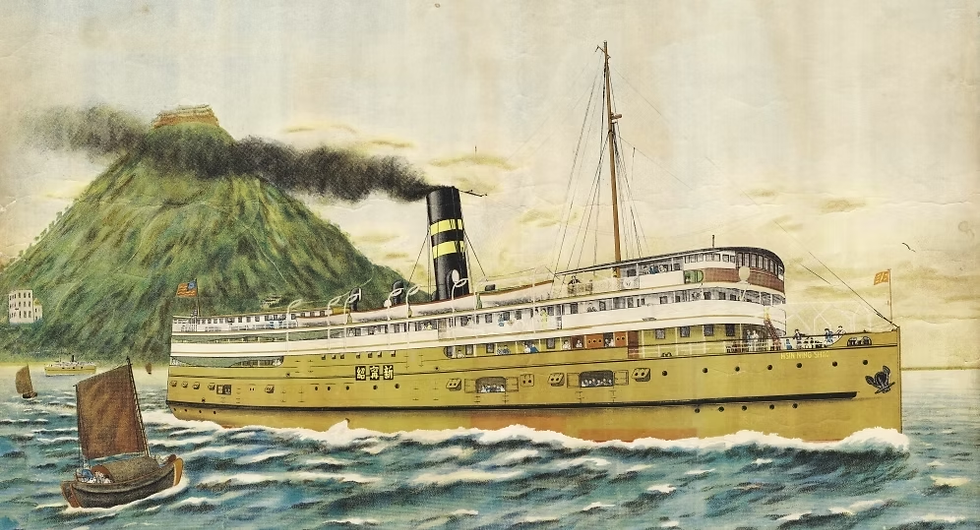
HSIN NINGSHAO
Despite the conditions which favoured the foreign companies and the state-owned China Merchants in the 19th and early 20th centuries, Yu Ya-ching (Yu Xiaqing) was notable in building up and managing a number of strong steamship companies with varied shareholdings including:
Ningshao S.N. Co. (1909)
San Peh S.N. Co (1914)
Hoong On S.N. Co. (1918)
Ningshin S.S. Co. (1918)
Chinese-Italian Navigation Co. Ltd (1937).
An updated text history (no ship photos) of the Yu Ya-ching (Yu Xiaqing) shipping companies written by Howard and published in "Sold East" in 1991 may be found in the first PDF at right. Updated illustrated fleetlists of the five Yu Ya-ching-managed companies, including those vessels of the Hoong On S.N. Co. fully managed from 1918, may be found in the second PDF.
Yu Xiaqing had the HSIN NINGSHAO, depicted above in an advertising poster, built in Shanghai in 1914 and operated her for Ningshao S.N. Co. (SK collection). The photo below is one of his cargo ships SUNG SHAN, photographed by Uhachi Kinoshita in the port of Otaru in Hokkaido around 1940 with 'MARU' painted as an unregistered addition to her name as seen below (Photo by Uhachi Kinoshita/Otaru City Museum).

SUNG SHAN
HISTORY & FLEET LISTS (PDF FORMAT)
Ching Kee Steamship Co.

SHENG LEE
Ching Kee S.S. Co. was the largest shipping company in North China in the first half of the 20th century. It was close to Japanese interests in Yantai (Chefoo) but in the 1930s some ships were sent to layup in Hong Kong to avoid Japanese takeover. The PDF file gives a brief outline and full illustrated list. The Ching Kee vessel shown above is the SHENG LEE, photographed laid up in exile at Hong Kong in March 1939 (D. Gammon/H. Dick).
HISTORY & FLEET LISTS (PDF FORMAT)
Kwang Chow Wan, Haiphong and Saigon

ALBERT SARRUT
As a supplement to our Marty & d'Abaddie (via the 'Singapore' page), Shun Cheong and Wo Fat Sing lists, we present a list of other Pre-WWII Chinese owned/chartered shipping from Hong Kong to Guangzhouwan (Kwang Chow Wan), Haiphong and Saigon in the PDF file. The list, which is not comprehensive, identifies those steamers in regular service for Chinese owners by the early 1920s, often working together in kongsi (syndicates) and generally with registry in Hong Kong, Canton or Macao. The ships often had unofficial Cantonese names which were different from their registered alphabetical names, and principally through the work of Peter Cundall, we endeavour to list these names as well. One of these ships, illustrated above with a photograph from the Perchoc collection in France, is the ALBERT SARRUT, chartered to Hong Kong operators in 1937-40 who advertised her as 大廣西 (TAI KUANG SAI) and painted this name on the ship's side as shown.
HISTORY & FLEET LISTS (PDF FORMAT)
Shawhsing Steamship Co. Ltd.

YUNG HSING
Shaw Hsing/Shawhsing/Zhaoxing S.S. Co. was a company based in Yingkou (Newchwang) from the 1920s until the late 1940s. An illustrated fleet list is in the PDF file. Shown above is Shaw Hsing's YUNG HSING carrying troops wearing padded uniforms in the Changjiang (Yangtse) in October 1929 (SK coll.).
HISTORY & FLEET LIST (PDF FORMAT)
Imperial Maritime Customs & Chinese Maritime Customs
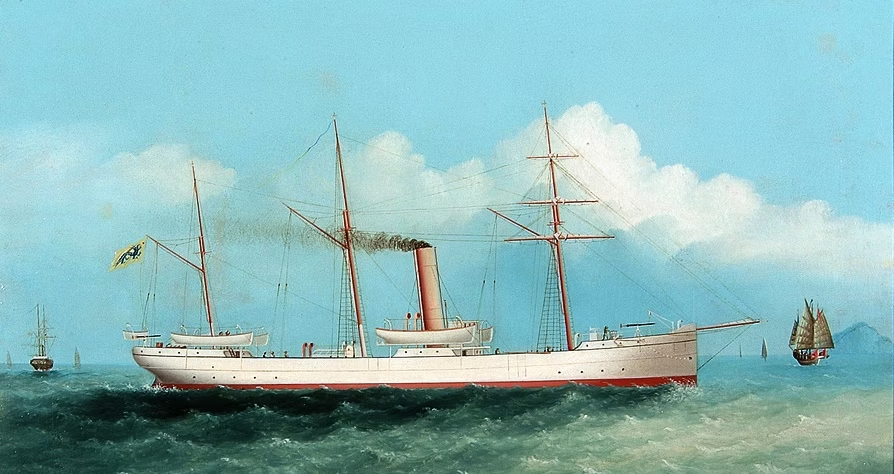
HAIYANG
The Chinese government-owned Imperial Maritime Customs later Chinese Maritime Customs was established in Shanghai in 1854 to collect on behalf of the Imperial Government the reparations sourced from tariff revenues due under the ‘unequal treaties’ that had been imposed at the end of the First Opium War in 1842. A fleet of steamships to enforce Customs regulations was developed flying the Chinese flag but, like the Customs bureaucracy, with foreign officers under contract. In due course a Marine Department was formed as a coastguard to improve the safety of navigation along the treacherous China Coast by constructing lighthouses and installing buoys beacons. Subsidiary activities were anti-smuggling and anti-piracy patrols, for which purpose and also for self-defence the vessels carried light armaments and were in most cases equivalent to gunboats but were referred to as ‘revenue cruisers’. The vessels policed and mapped the China coast and major rivers inland including the Songhua (Sungari) and also assisted with rescue and salvage. Although these steamers were ubiquitous on the China coast and often part of ceremonial events such as fleet reviews, they are little documented, not generally appearing in Lloyd’s Register, maritime directories or navy lists. The list in the PDF file is an attempt to provide a record of the larger vessels, but still lacks information so contributions of relevant data and/or images would be much appreciated. The two vessels depicted below are a LIKIN class (1888) revenue cruiser (Chinese school painting in HKMM) and the HAI HSING (1924) depicted in a review at Shanghai about 1946 (Internet image).
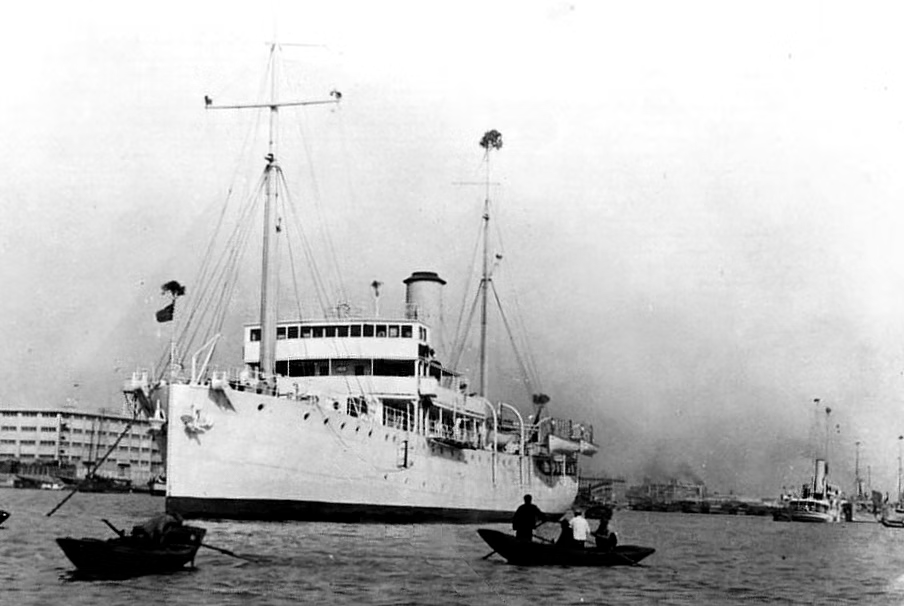
HAI HSING
HISTORY & FLEET LISTS (PDF FORMAT)
Charles Eddie Hsu

KONDOR
Charles Eddie Hsu from Zhoushan was a successful and popular self-made businessman in Shanghai who entered shipowning in 1922 and in the time until his death in 1941 owned and embellished around ten mainly passenger steamers operating in the Changjiang (Yangtse) river delta, to Dinghai and Ningbo and further afield as outlined in the illustrated PDF file. But in addition his contribution to shipping is very significant in terms of the fleets built up by his sons and grandchildren. Subsequent oceangoing vessels in one of the world’s largest fleets developed from 1947 by son W.H. Eddie Hsu are detailed in ‘W.H. Eddie Hsu & All His Ships’ (and may be found on the ‘New Wave’ page of oldchinaships.com). The eldest son Vung-Kwei ‘Eddie’ Hsu developed Oak S.S. Co. Ltd, a major player based in Hong Kong. A fleet of bulk carriers was managed from Taipei by a grandson, C.C. Hsu. Shown above in a painting by Robert G. Lloyd based on actual photographs is one of his vessels, KONDOR, believed originally built at Guangzhou (Canton) in 1889 for the Chinese Navy.
HISTORY & FLEET LISTS (PDF FORMAT)
"Pei" Ships

PEI MING
There were two companies based in Tianjin (Tientsin) which used "PEI" nomenclature for their ships, and these are presented in the PDF. Shown in the photo above is PEI MING of Tientsin Nav Co. which was carrying passengers and cargo between Tianjin and Shanghai in the late 1940s (SK coll.).
HISTORY & FLEET LISTS (PDF FORMAT)
Chung Hsing Steamship Co. Ltd.

ZHANDOU
Chung Hsing was a major concern, commencing with the company's coal mining operations in Shandong in 1880. It operated colliers from the 1930s and later steamships out of Shanghai, including after 1949. A short history and illustrated fleetlist is in the PDF file. The German-built steamer illustrated above was acquired by the Chung Hsing Coal Mining Company in 1935 and renamed LU HSING 魯興 . After a series of transfers it ended up with the Shanghai Maritime Bureau as the ZHANDOU 16 and is shown as such in Karsten Petersen's 1973 photo at Qingdao.
HISTORY & FLEET LISTS (PDF FORMAT)
Wah Shang Steamship Co. Ltd.

HAVEN 海文
Wah Shang Steamship Co. Ltd. managed by Yeh Chuan-fang, was a shipping company established in Shanghai in 1931. Its story and that of its successor companies is outlined in the PDF. Shown above at Shanghai is one of that company's ships, the HAVEN 海文, acquired after the Second World War (Howard Dick coll.).
HISTORY & FLEET LISTS (PDF FORMAT)
Dah Loh Industrial Co. Ltd.

DAH KIANG 大江
Dah Loh Industrial Co. Ltd was another sizeable company operating out of Shanghai before and after World War II. An illustrated fleet list is contained in the PDF. Peter Kiehlmann's photograph above shows the DAH KIANG 大江, similarly acquired after World War II.
HISTORY & FLEET LISTS (PDF FORMAT)
Wo Fat Sing

HELIKON
A number of operators developed the trade out of Hong Kong southwards, often carrying workers outward and bringing back rice from Indochina. One of these operators, Wo Fat Sing, became prominent in the Prewar period. A short history and illustrated fleet list of Wo Fat Sing and its precursor Li Shek Pang is in the PDF file. Two photos by Don Gammon of Wo Fat Sing ships are shown here. Above, kindly edited for us by Russell Priest, shows HELIKON at Xiamen (Amoy) in the 1930s taking on cargo. The second below depicts LYEEMOON at Hong Kong in September 1939 with passengers, with the ship painted in darker colours for camouflage. In both photos the ships appear to be flying the houseflag of Jardine, Matheson & Co.

LYEEMOON
HISTORY & FLEET LISTS (PDF FORMAT)
Hai-Chang / Min Chu 2

HAI-CHANG
The KPM’s Original Thirteen and the Long Afterlives in China and Japan of VAN DIEMEN, SPEELMAN and SWAERDECROON in the PDF file tells of the original 13 ships of the Koninklijke Paketvaart Maatschappij (KPM) which in January 1891 took over the mail contract for the Netherlands East Indies, now Indonesia. This study discusses the ships' origin, design, careers and the vessels they operated with. We have particularly focussed on the careers in China and Japan of three of the ships which lived past the age of 50 years. Sold at first to Indochina, VAN DIEMAN and SPEELMAN passed to respective owners in China. Shown above from a postcard is HAI-CHANG ex SPEELMAN moored in the Liao River at Yingkou (Newchwang) in the 1930s.
HISTORY & FLEET LISTS (PDF FORMAT)